
Note: all opinions are my own and do not represent my employer or NASA.
At the beginning of 2025, I was selected to be a member of the Artemis II science and mission operations team. Practicing simulations, developing procedures, starting over and getting better, learning lunar geography, figuring out how science will work in this era of human spaceflight compared to the Apollo missions. When Artemis II launches to the Moon this year, I will be a crew data analyst supporting from the Science Mission Operations Room, a Mission Control backroom for the Science console in the Artemis II Flight Control Room. This is the kind of history I have read and watched and been inspired by nearly all my life in my artwork. So of course I dug back into the history of lunar exploration, the people who made it happen, and the traditions I was joining to find my path forward as an artist on a science team.
NASA Art Program
In 2019, I saw Robert Rauschenberg’s Stoned Moon series of 34 lithographs in Moon Shot, exhibited at the Moody Center for the Arts at Rice University. Rauschenberg created these after joining NASA’s Artist’s Cooperation Program and attended the launch of Apollo 11 in 1969.
Administrator James Webb started the program in 1962, giving artists access to launches, Mission Control, and the astronauts and employees. In this infancy of space exploration, artists created new work which bridged the gap between science fiction and real endeavors for the public in a different way than news articles and press briefings.

The NASA Art Program waxed and waned with the rest of NASA’s missions such as Shuttle, Mars exploration, and space telescopes. In 2024, the previous deputy administrator relaunched the program with murals in New York but no other work or announcement has come since. (Thankfully, much of the artwork created because of this program is now in the collection of the National Air and Space Museum, which is planning The Ascent of Rauschenberg: Reinventing the Art of Flight and The Art of Air and Space: Interpretation of Flight exhibits, to open on July 1, 2026.) Occasionally, NASA will invite artists to NASA Social events to document and share online. Jedidiah Dore will be reportage drawing and painting at the launch of Artemis II.
Marta Kranz’ Vests
During the Apollo and other human spaceflight missions, Marta Kranz sewed vests for her husband, flight director Gene Kranz. The first vest for a mission was all white, as Gene was lead of the white team. Upon splashdown, Gene would change into a colorful vest to celebrate the successful mission.
Ultimately, according to NASM curator Margaret Weitekamp, Kranz’s Apollo 13 vest would not only become a morale booster for his team, but also ‘a symbol for something much bigger than that.’ – Owen Edwards
Continuing Traditions
Inspired by the art and traditions of the Apollo era, I thought on how I wanted to continue these in the Artemis era. NASA historian Dr. Jennifer Ross-Nazzal presented to the Artemis science team this past summer on the importance of personal documentation. I’m extremely privileged to be part of the science team, learning from my amazing team members, and seeing a new moment in history, not just launch, but be created. My artwork has always used the symbols and imagery of space exploration, so this wasn’t completely new territory for me. But instead of documenting other people’s rituals and experiences of space exploration, I will be directly experiencing and participating in the rituals.
Following Marta and Gene Kranz, I have made myself a vest to wear during the mission. This combination of textiles, traditions, and now-historic imagery is the perfect intersection of my interests and art practice. While the science team does not have an official color, blue is a recurring theme for the science team.
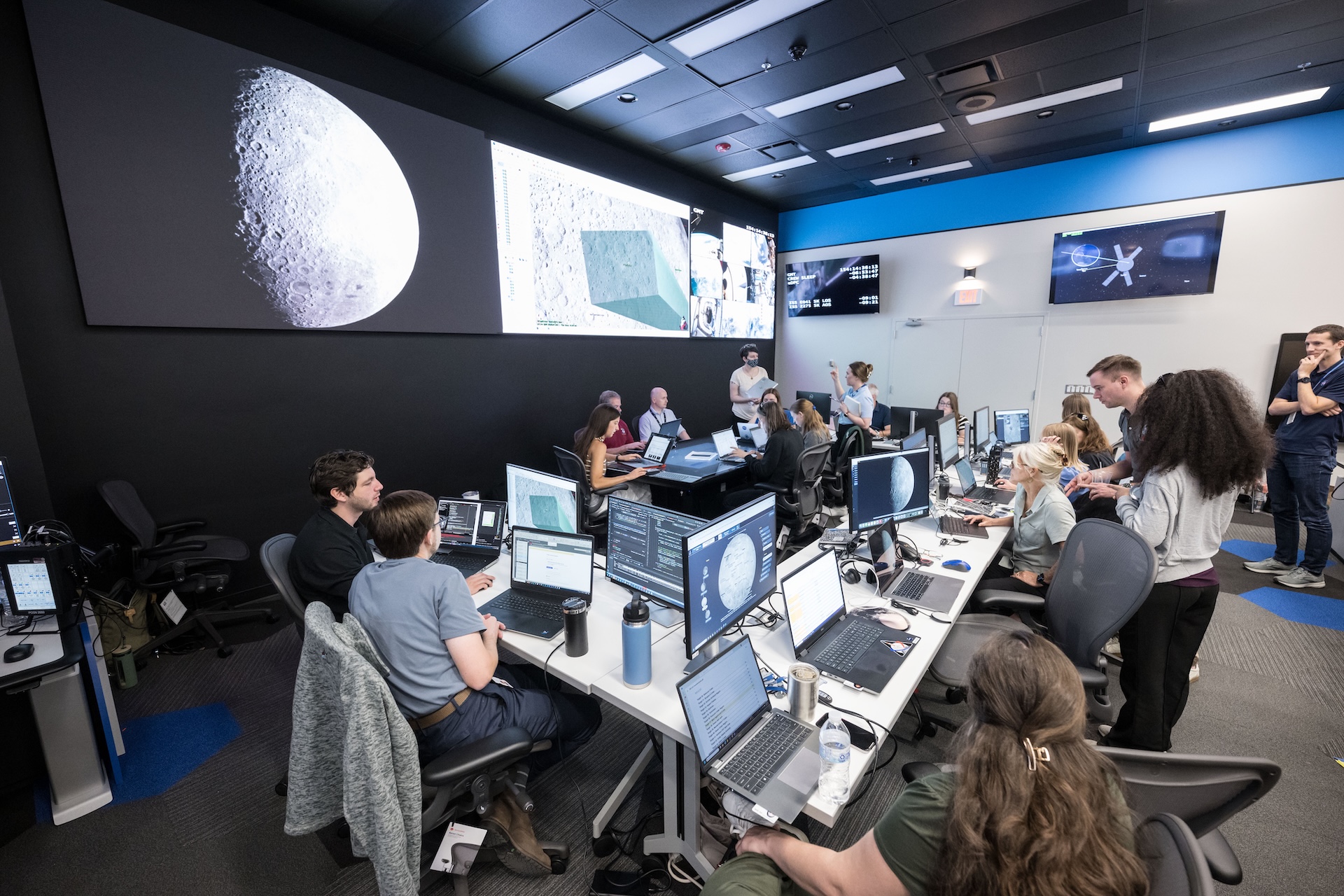
Beyond its technical capabilities, the [Science Evaluation Room] also incorporates visual design elements meant to inspire. A bold blue line near the ceiling symbolizes Earth, while the room’s carpeting – patterned in gray, blue, and red – depicts a two-dimensional projection of the crystalline structure of anorthite, the Moon’s dominant mineral. Together, they give the sensation of standing on the Moon while looking back at Earth. – NASA’s Artemis Science Team Inaugurates Flight Control Room
I don’t sew very well, but I can knit! I modified Sara Ottosson’s Cambridge vest pattern and used Malabrigo Rio in Bobby Blue and Gris to create an alternating blue and gray vest symbolizing the connection between the Earth and the Moon. I plan to wear this every day of the mission.

I scoured my mom’s button collection for about half the buttons, Ebay for the other half, to find buttons depicting the Moon, stars, and rockets. One even celebrates Apollo 11’s lunar landing and the first Moonwalkers. Even though Artemis II is not landing, I included this button to show the impact of Apollo and throughline to today’s mission. Lastly, I crocheted a heart in memory of Michelle Parten Benton, who would have been so excited to see Artemis fly.

I have been and will continue to document my thoughts and view of the mission through writing, sketching, photography, list making, quote taking, researching, listening – collected in the below journal. This will serve as both standalone work and contributions to future artwork I make after the rush of the mission has concluded.


